There is no required order for names on a family bracelet. Choose an order that the wearer understands, then record it clearly. Alphabetical order, birth order, and a personal grouping can all work; the important part is knowing which order the maker will use.
Name selection and name arrangement are separate decisions. Settle the list first. Otherwise, you can spend time balancing a layout that changes when someone is added or a spelling is corrected.
Choose an ordering rule you can explain
Consider three fictional names: Ada, Eli, and Nora. Here are different ways to approach the same list.
| Approach | When it may help | What to check |
|---|---|---|
| Alphabetical | You want a neutral, repeatable rule | Which form of each name you are alphabetizing |
| Birth order | The sequence already has meaning to the wearer | That everyone agrees on the intended order |
| Personal grouping | Names represent different parts of a family | The grouping is wanted by the wearer, rather than assumed by the giver |
These are planning options, not statements about which relationship matters most. If the gift involves a blended family, a changed name, or someone who prefers not to be named publicly, ask before fixing the inscription.
Write an ordered list, not a loose sentence
An instruction such as “Ada Eli Nora” leaves room for confusion. Is it one inscription? Three separate areas? Are the spaces part of the requested text?
Instead, write a numbered list:
- Ada
- Eli
- Nora
Keep spelling, capitalization, and any accents in the list. If a name requires a character the maker has not confirmed, leave that issue open until you receive an answer. Do not replace it with an approximate spelling without the wearer’s permission.
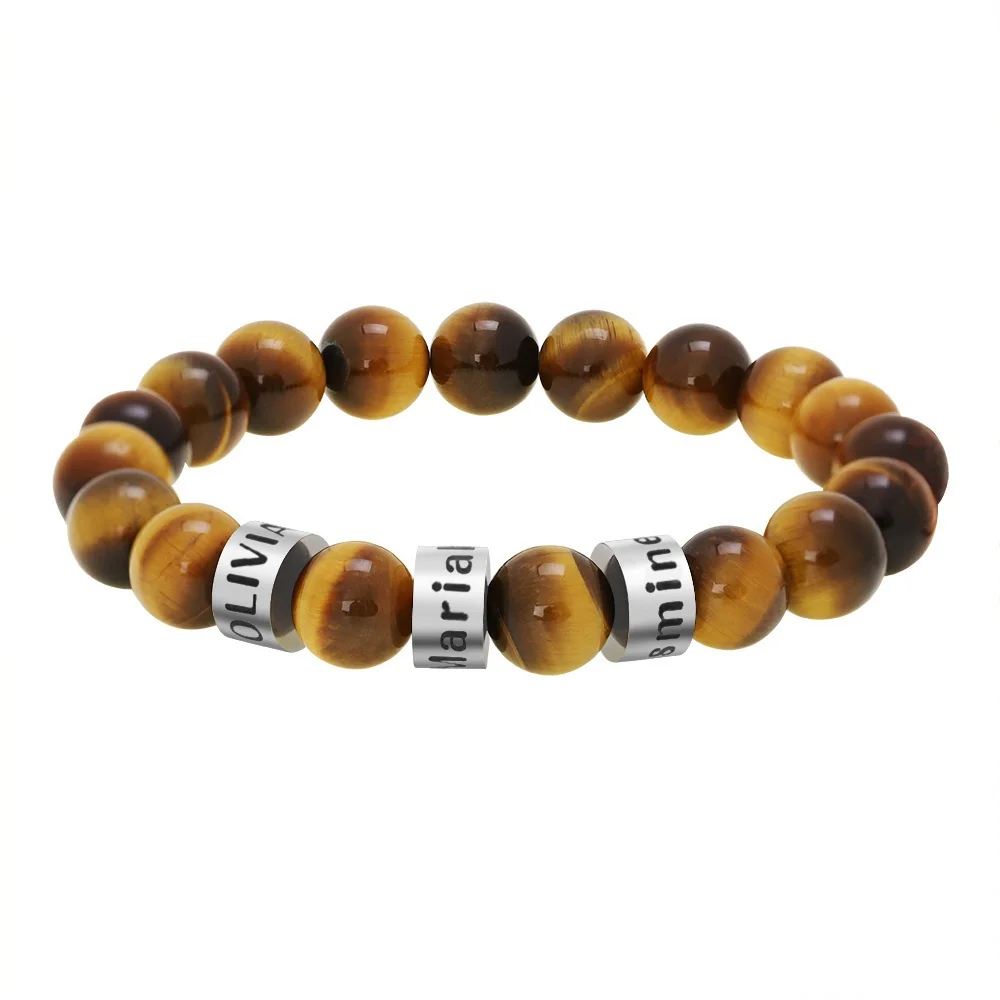
Define the direction of the list
“Left to right” is only useful when everyone is looking at the design the same way. A bracelet can be photographed flat, rotated, or shown from its opposite side.
Ask the seller to identify the first position on a proof or diagram. Then attach your numbered list to that orientation. If the only available tool is an on-screen layout preview, save the view you intend and ask whether the production order follows it. A reference preview alone is not that confirmation.
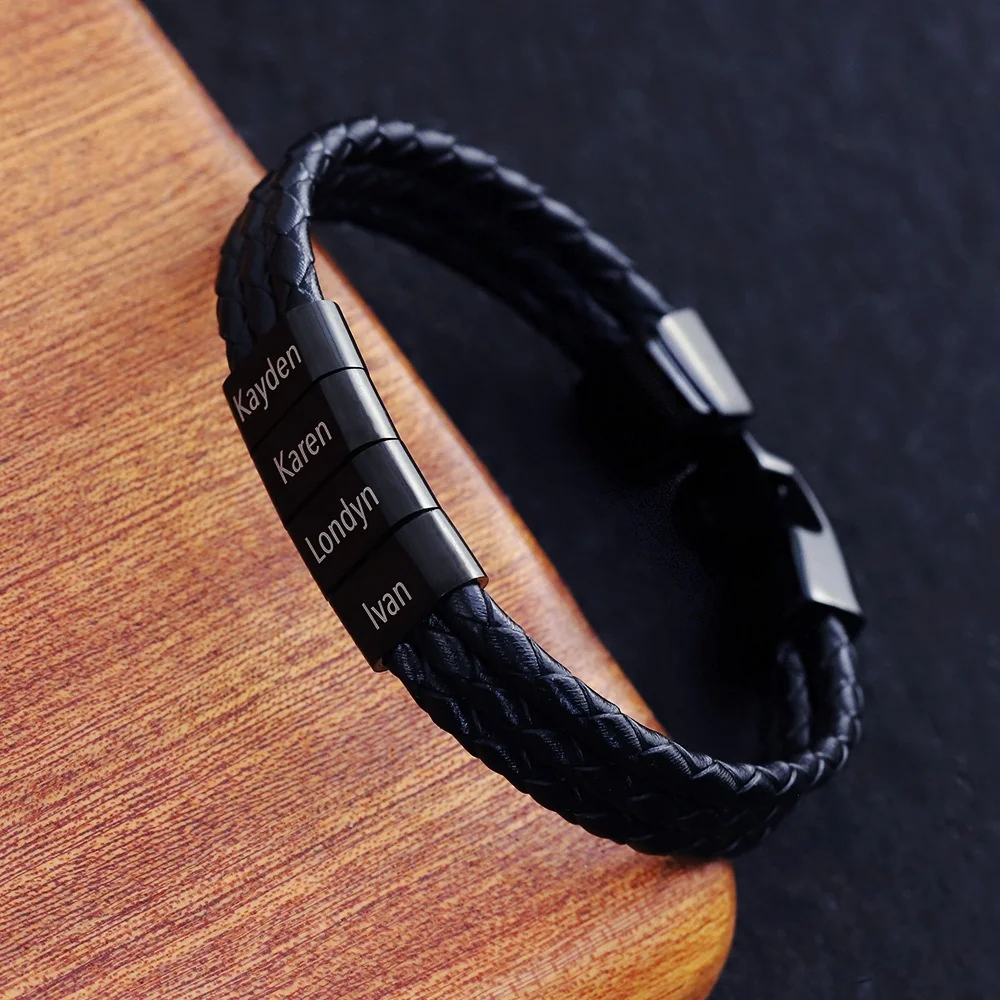
The Family Bracelet shows an example of separate name elements on a braided band. The photograph is useful for thinking about sequence. It does not confirm an approved maximum number of names, the finished lettering, or the ability to rearrange the parts after delivery.
Deal with the list before changing the design
If your planned names do not fit a confirmed design, you have several decisions to make. You might choose a different piece, choose a shared word, or use initials that the wearer accepts. Adding more elements or using smaller lettering is only an option when the maker confirms it.
Do not plan around adding a new name later unless the product is explicitly documented as expandable. A bracelet that appears to have separate elements may still require a new build or may have no alteration service.
For a gift, keep the final name list with the note you plan to include. The note can explain the ordering choice without asking the inscription to carry every detail. Before approval, compare the list and the proof line by line, including the first position and reading direction.
Check adjacency as well as the written rule
A sequence around a bracelet has neighbors. After numbering the list, note whether any pair should appear together and whether the first and last entries might meet when the arrangement is viewed around the wrist. This is a planning question for the confirmed layout, not a promise that its parts can be repositioned.
In a fictional example, the wearer chooses Ada, Eli, and Nora alphabetically. A proposed view starts at Nora, then continues to Ada and Eli. All three names are present, but the indicated start point does not match the brief. The wearer requests a labeled first position rather than assuming that a circular arrangement makes every rotation equivalent. If the wearer is happy with either start, that flexibility can be recorded explicitly.
Make a simple paper list beside a sketch of the closure or another identified landmark. The sketch is an editorial communication aid, not a scale drawing or manufacturing instruction. Its purpose is to show which numbered entry belongs at the start of the intended view. Retain the actual product proof separately so the sketch cannot be mistaken for a confirmed component arrangement.
Revise the list before rebalancing the appearance
When one spelling changes or another person is included, create a new numbered list. Reapply the chosen ordering rule to that list instead of asking the designer to insert the new entry wherever there is visual space. If the wearer wants a different personal grouping, record the revised rule before layout begins.
Check that the final proof uses the current list version. A balanced image from an earlier list can remain in a folder and accidentally look final. Include a brief version name and identify any changes from the earlier draft. The result should let another reviewer reconstruct both the chosen sequence and its orientation without relying on a verbal explanation.
