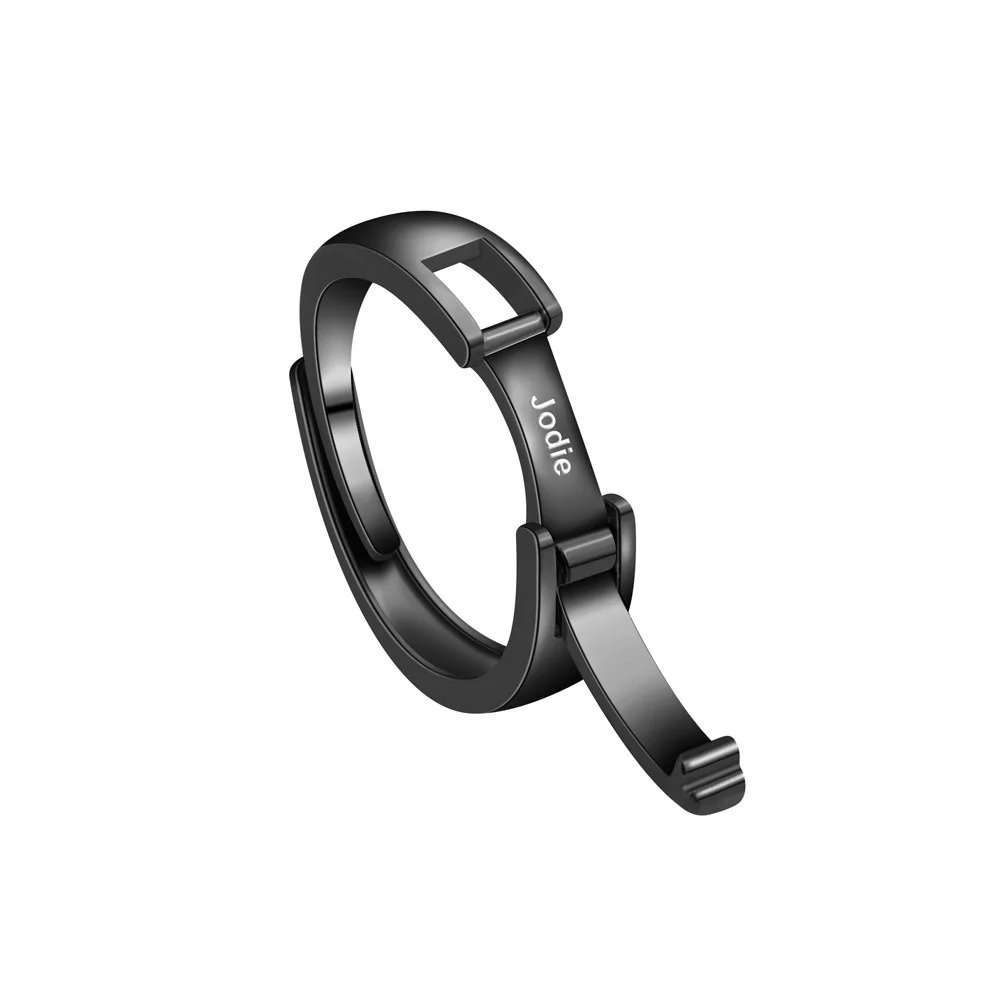
An open ring still needs a fit specification. The visible gap does not establish its intended finger range or authorize bending.
Start with the intended finger
Record which finger and hand the wearer plans to use. The GIA sizing guide describes professional finger gauges as a sizing method. Such a measurement still needs to be related to the specific ring construction and supplier option.
The Name Ring current record does not supply a sales-approved size range. Ask for its size definition, the intended range, and whether adjustment is actually supported.
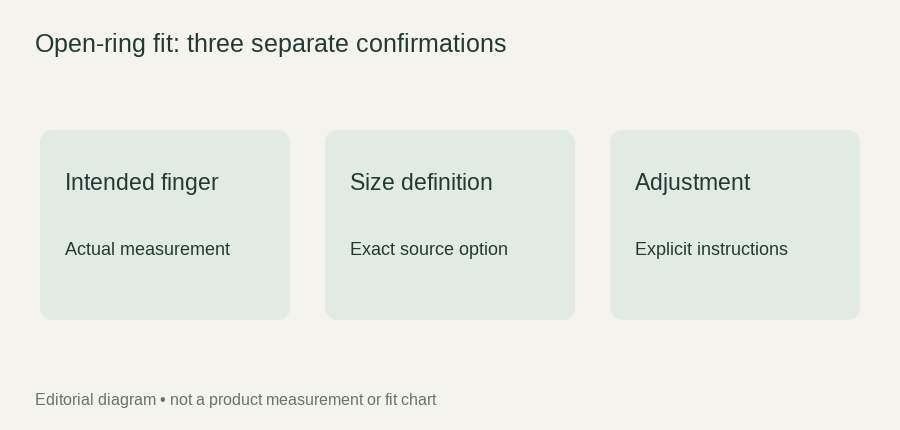
Require an explicit adjustment answer
If adjustment is offered, ask who should do it and what instructions apply to this exact version. Do not push the ends together based on a different open-ring tutorial.
Keep the engraving choice separate while fit is unresolved. A correct name proof does not resolve the opening, band construction, or wearing size. If the supplier cannot explain the fit, retain the ring as a visual reference and choose a design with a confirmed sizing route.
Make an intended-finger record
Write the hand and finger before collecting any size reference. A ring comfortably worn on another finger does not document the fit you are trying to obtain. If the recipient has not chosen a finger, settle that preference first. You can prepare name wording meanwhile, but the fit question still lacks its intended location.
Identify where any measurement came from. It might be a professional gauge reading, a labeled ring already worn on the intended finger, or an approximate inner-opening observation. Do not make these records sound interchangeable. Keep the method beside the number and preserve any uncertainty. A size label from another seller also needs its sizing-system definition before it can be compared meaningfully.
Describe the existing reference ring's structure if you use one. A closed plain band and an open design with a prominent top can raise different product-specific questions. That observation does not justify calculating an adjustment yourself. It tells you what information to include when asking how the candidate's intended size is determined.
Ask what the open shape permits
The visible separation between the ends is a design feature. Ask whether the manufacturer treats the ring as fixed in that shape, provides several starting sizes, or approves a particular adjustment. Those are distinct possibilities. Do not let a descriptive phrase such as open band become a substitute for the answer.
If an adjustment is confirmed, request the intended range and the method's source. Ask whether the action is meant for the wearer or a professional. Keep any stated limits and warnings with the exact option. A general video about open rings cannot establish instructions for this one, even if the top looks similar.
Avoid testing the possibility by pushing the ends together or opening them farther. The preparation task is to obtain a documented sizing route. It is not to discover a product's behavior through an unapproved alteration. If the seller cannot identify a range or method, the adjustment field remains unavailable rather than becoming a trial-and-error instruction.
Work through a fictional fit decision
In this fictional example, a wearer wants a name ring for the right index finger. Their existing ring on that finger has a known comfortable fit, but its size label comes from another brand. They record the brand's label as a reference and seek a professional measurement or a clear diameter reading rather than copying the label directly into the new option request.
The candidate's gallery shows a gap, and the first reply calls it a universal fit. The wearer asks what intended finger range that phrase represents and whether the manufacturer supplies an adjustment procedure. Without those details, the open shape has not resolved fit. The wearer can retain the visual design in the shortlist while choosing another ring with a defined sizing route if a decision must be made.
If a later answer provides a specific size range, the wearer compares their documented reading with that range and reviews the proposed option. They then attach the accepted name spelling to that exact version. Changing the intended finger afterward reopens the sizing question; the previous approval was tied to the original location.
Keep name placement connected to the supported structure
An inscription shown along a band segment should be reviewed on the shape and option actually discussed. A proposed adjustment might raise a placement question, but the current record does not establish what changes are possible or how the lettering would be affected. Ask for a proof on the supported configuration instead of assuming the existing mockup remains valid.
Save the size explanation, selected version, intended finger, and accepted placement view together. If only the name has been approved, label only that choice complete. The useful result is a ring selection whose fit and wording have separate, traceable answers. Open construction may be part of the design you like, but it still needs its own size evidence.
If more than one person is involved in the gift, have one person maintain the final fit record. A relative may remember a ring worn on another hand, while the recipient has chosen this one for a different finger. Retain those references with their locations rather than combining them into a single guessed size. The selected finger and the supporting measurement should remain visible together when the option is discussed.